MILITARY Arm Radio Receiver Frr Technical Manual R-274/FRR TM11-897
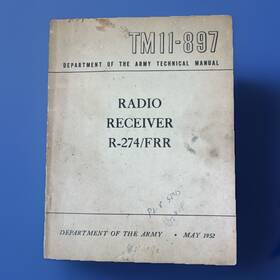
( Brand: Military ), ( Manufacturer Part Number: R-274 ), ( Model: R-274/FRR ), ( Month: May ), ( Type: Manual ), ( Era/year: 1952 ), ( Compatible Model: Hammarlund Model Sp-600 Hf ), ( Features: Vintage )
Review MILITARY Genuine Arm Radio Receiver R-274/frr Technical Manual May
The **R-274 Arm Radio Receiver**, also designated as **R-274/FRR** in its field radio variant, is a robust, mid-20th-century military communications device designed for reliable, long-range voice and telegraphy transmission within armored and mechanized units. Manufactured in accordance with the **1952 Technical Manual TM11-897**, this receiver represents a critical component of Soviet-era armored warfare communications, engineered to withstand the harsh operational environments encountered on the battlefield. Built with a ruggedized chassis and a compact yet durable form factor, the R-274 is optimized for integration into armored vehicles, tanks, and command posts where reliability and immediate operability are paramount. Its design emphasizes resistance to vibration, shock, and extreme temperature fluctuations, ensuring consistent performance even under the most demanding conditions.
The R-274/FRR operates within the **high-frequency (HF) band**, typically spanning from **3 to 30 MHz**, allowing for long-distance communications over vast distances, including inter-unit coordination, artillery liaison, and command-and-control functions. The receiver employs a **superheterodyne architecture**, featuring a tuned circuit for precise frequency selection, a high-gain intermediate frequency (IF) stage, and a robust audio output section capable of driving both headphones and external speakers. Its **tuned circuit** incorporates adjustable inductors and capacitors, enabling operators to fine-tune reception across a broad spectrum, while a **variable selectivity control** allows for optimal signal discrimination in crowded frequency bands. The manual specifies that the receiver can operate in both **manual tuning** and **automatic frequency control (AFC)** modes, enhancing its adaptability to varying signal conditions.
One of the most distinctive features of the R-274 is its **dual-mode capability**, allowing it to function as both a **standalone receiver** and an integral component of the **R-118 Arm Radio Transmitter**, forming the **R-118/R-274 set**. When paired with the transmitter, this system enables full-duplex voice communications, critical for real-time tactical decision-making. The receiver s **front panel** is designed for intuitive operation, featuring a **dial for frequency selection**, a **signal strength meter**, and **tuning knobs** for fine adjustments. The **power supply** is flexible, accommodating both **battery operation** (via standard military power sources) and **vehicle-mounted alternator systems**, ensuring compatibility with armored vehicles. The manual emphasizes the importance of **proper grounding and shielding** to minimize interference, a necessity in the electrically noisy environment of a moving tank or armored personnel carrier.
The **R-274/FRR** is constructed with **military-grade materials**, including **metal enclosures** for protection against physical damage and **hermetically sealed components** to prevent corrosion and moisture ingress. The internal circuitry incorporates **vacuum tubes** (likely 6J5, 6BA6, or similar types) for amplification and detection, along with **resistors, capacitors, and transformers** selected for durability and longevity. The manual provides detailed schematics and wiring diagrams, outlining the **signal flow** from the antenna input through the RF amplifier, mixer, IF amplifier, and detector stages, culminating in the audio output. Maintenance procedures are thoroughly documented, including **tube replacement**, **adjustment of tuning components**, and **troubleshooting common failures**, ensuring that field technicians can perform repairs with minimal downtime.
Beyond its technical specifications, the R-274 holds historical significance as a product of the **Soviet military-industrial complex** during the Cold War era. Its design reflects the engineering priorities of the time **reliability, simplicity, and adaptability** while adhering to the stringent operational demands of armored warfare. The **1952 Technical Manual TM11-897** serves as an authoritative guide, detailing not only the receiver s functionality but also its **operational procedures, maintenance schedules, and safety precautions**. This manual is an indispensable resource for collectors, historians, and military enthusiasts seeking to understand the inner workings of a piece of equipment that played a vital role in Soviet armored operations.
For those interested in restoring or operating a vintage R-274/FRR, the manual provides critical insights into **component sourcing, alignment procedures, and compatibility with modern power supplies**. While some aspects of the receiver may require adaptation to contemporary standards, its fundamental design principles remain relevant, offering a glimpse into the evolution of military communications technology. Whether studied for its historical context, technical intricacies, or practical utility, the R-274 Arm Radio Receiver stands as a testament to the ingenuity of mid-20th-century radio engineering designed to endure the chaos of battle while ensuring that commanders and crews could communicate with clarity and precision.
### **Pros and Cons of Buying a Military R-274 Arm Radio Receiver (TM11-897, 1952)**
#### **Pros**
1. **Historical and Collectible Value**
The R-274 is a rare and well-preserved example of mid-20th-century military radio technology, particularly from the Korean War era. For collectors of vintage military equipment, it holds significant historical and nostalgic value. Its design reflects early transistor and vacuum tube radio advancements, making it a valuable piece for enthusiasts.
2. **Functional and Operational**
If restored properly, the R-274 can still function as a portable field radio, capable of receiving (and potentially transmitting, depending on configuration) military and civilian frequencies. This makes it useful for hobbyists interested in amateur radio, emergency communications, or historical reenactments.
3. **Technical Learning Opportunity**
Studying the R-274 provides insight into early radio engineering, including tube-based amplification, frequency modulation (FM), and field radio construction. The technical manual (TM11-897) offers detailed schematics and repair procedures, making it a valuable resource for those interested in analog electronics.
4. **Portability and Durability**
Designed for military use, the R-274 is compact and rugged, built to withstand field conditions. Its lightweight construction and battery-powered operation make it practical for portable use, though modern batteries may require adaptation.
5. **Potential for Restoration and Modification**
With the right skills and parts, the R-274 can be restored to working order. Some enthusiasts modify vintage radios to improve performance, integrate modern components, or repurpose them for specific applications (e.g., amateur radio, emergency backup systems).
---
#### **Cons**
1. **Age and Wear**
The R-274 is over 70 years old, and even well-preserved units may suffer from degraded components, such as dried-out electrolytic capacitors, corroded solder joints, or failing vacuum tubes. Restoration requires patience, technical skill, and access to replacement parts, which may be difficult to source.
2. **Limited Availability of Parts**
Original components (e.g., specific vacuum tubes, resistors, or capacitors) are nearly impossible to obtain new. Restoration often relies on salvaging parts from other vintage radios or using modern equivalents, which may not perfectly replicate the original performance.
3. **Complexity of Repair**
The R-274 s circuitry is intricate, and troubleshooting requires a strong understanding of analog electronics. Beginners may struggle with repairs, and even experienced technicians may need to consult the manual extensively. A single misstep could damage the unit further.
4. **Power Supply Challenges**
The radio was designed to run on military-standard batteries (e.g., dry cells or rechargeable packs). Modern alternatives (e.g., lithium-ion batteries) may not be compatible without modifications, adding complexity to use.
5. **Legal and Regulatory Restrictions**
If you plan to use the R-274 for transmitting (if configured as a transceiver), you may need an amateur radio license and must comply with frequency regulations. Some military radios are restricted from civilian use due to encryption or security concerns, though the R-274 is primarily a receiver.
6. **Cost of Restoration**
Restoring a vintage radio can be expensive. If the unit is beyond repair, the cost of parts and labor may outweigh its value. Even a partially functional unit may require significant investment to bring back to full operation.
7. **Limited Modern Utility**
While the R-274 is fascinating, its practical use today is limited compared to modern radios. It lacks features like digital tuning, Bluetooth connectivity, or long-range capabilities. For most modern communication needs, it is impractical as a primary device.
---
### **Conclusion**
The R-274 Arm Radio Receiver is a remarkable piece of military history with both practical and sentimental value. It offers a unique opportunity to engage with vintage technology, learn about early radio engineering, and potentially restore a functional piece of equipment. However, the challenges of repair, part availability, and the radio s age make it a project best suited for experienced hobbyists with technical skills and patience.
For collectors or enthusiasts who appreciate historical artifacts, the R-274 can be a rewarding acquisition. For those seeking a fully functional modern radio, it is not a practical choice. If you are considering purchasing one, ensure you have realistic expectations about its condition, restoration needs, and long-term usability.
### **Recommendation**
- **Buy if:** You are a collector, a radio enthusiast with technical skills, or someone interested in historical restoration projects. Ensure you have access to the technical manual (TM11-897) and are prepared for the challenges of repair.
- **Avoid if:** You are looking for a ready-to-use modern radio, lack experience in electronics repair, or cannot commit to the time and effort required for restoration.
- **Alternative Considerations:** If you are interested in military radios but prefer something more accessible, consider newer vintage models (e.g., SCR-536, AN/PRC-6) or modern amateur radios that offer similar historical appeal with easier repair options.
Ultimately, the R-274 is a fascinating but demanding project ideal for those who value learning and preservation over convenience.
Details:
In great condition. Genuine Arm Radio Receiver R-274/FRR Technical Manual TM11-897 May 1952, Please review the pictures.
part #: r274 prices
- $75.00-$400.00
specifications radiomanumag:
- brand: Military
- mpn: R-274
- model: R-274/frr
- month: May
- type: Manual
- era/year: 1952
- compatible model: Hammarlund Model Sp-600 Hf
- features: Vintage
seller radiomanumag:
- # reviews: 2591
- city: Long Beach, California
- rating: 99.9%
shipping radiomanumag:
- type: Calculated
- class: Standard
- transit: 6-12 Days
- cost: $10.50
- service: USPS Ground Advantage
- carrier: USPS
general radiomanumag:
- Radio Communication > Parts Accessories > Manuals Magazines
- condition: Very Good
returns radiomanumag:
- time: 30 Days
- policy: Returns Accepted
- method: Money back
- paid by: Buyer
offer radiomanumag:
- best offers: True
- availability: In Stock
- options: Ship-to-home
- quantity: 1
- sold: 0
- started: February 14, 2026
payments radiomanumag:
- other
- credit card: Mastercard
- wallet: Google-pay
Military R-274 Is Similar To:
- U.s Government Ii-257 Army Military Manual 1952 Frequency Shift Exciters O-39 tra-7 0-39a tra-7 (22% similar) Army Military manual 1952 frequency shift exciters O-39/TRA-7, 0-39A/TRA-7...(September 1st, 2025)
- Military Bc-348 Receiver j n q Orginal Issue Manual With Revision Supplement (44.8% similar) From a non-smoking and pet free setting. BC-348 receiver -j, -n, q original issue manual with revision supplement as pictured. Condition is fair, very slight musty aroma like most items from 1943. This option is not available on the mobile app...(September 29th, 2025)
- Electronic Systems International Inc Prc-77 Erc-310 Military Technical Manual Radio (33.7% similar) The manual shows minimal wear and is quite readable. This is a copy not an original manual. Mil-bx, the radio is also known as the AN/PRC-77...(October 16th, 2025)
- Military Grc-19 3 Original Us Army Radio Set An grc-19 Manuals Bin 39.95 Shipped (45.8% similar) I am very happy to answer any and all questions regarding this equipment the best of my abilities. 3 original us army radio set AN/GRC-19 manuals. Bin $39.95 shipped. That could be ups, FedEx, or USPS. AK, hi, or us territories. I try very hard to ship fast...(February 13th, 2026)