NATIONAL 23RF-2 Radio Institute Broadcast Wave Television Superheterodyne
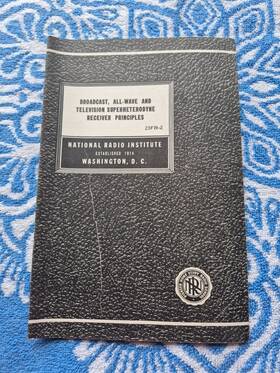
( Brand: National ), ( Manufacturer Part Number: 23RF-2 ), ( Type: Handbook ), ( Language: English ), ( Era/year: 1943 ), ( Features: Vintage ), ( Country Of Origin: United States )
Review NATIONAL Radio Institute Broadcast All Wave And Television Superheterodyne Receive
The **National 23RF-2 Radio Institute Broadcast Wave Television Superheterodyne Receiver** stands as a remarkable piece of mid-20th-century engineering, embodying the ingenuity of an era when radio and early television technology were rapidly evolving. This versatile broadcast receiver was designed to capture both standard AM/FM radio signals and early television broadcasts, making it a pioneering hybrid device for its time. At its core, the **23RF-2** operates on the principles of **superheterodyne reception**, a method that dramatically improved signal clarity and selectivity by converting incoming radio frequencies to a fixed intermediate frequency (IF) for processing. This design allowed it to efficiently tune into a wide range of broadcast waves, from longwave and mediumwave AM signals to shortwave transmissions and even the experimental television broadcasts of the 1940s and early 1950s.
Physically, the **23RF-2** is a robust, all-metal chassis, likely constructed from die-cast aluminum or steel, giving it a sturdy and professional appearance befitting its role as a broadcast-grade receiver. The front panel features a **rotary tuning dial** with a calibrated scale, allowing operators to precisely navigate through radio frequencies and television channels, while a **band selector switch** enables quick switching between AM, FM, and television modes. Additional controls include a **volume knob**, a **tuning sensitivity adjustment**, and a **signal strength meter**, providing real-time feedback on reception quality. The rear panel houses essential connections such as an **antenna input**, **headphone jack**, and **speaker output**, along with a **power switch** and **AC adapter terminal**, ensuring flexibility for both portable and fixed installations.
Internally, the **23RF-2** incorporates a sophisticated array of vacuum tubes, including a **mixer tube**, **IF amplifier tubes**, and a **detector tube**, all working in harmony to demodulate and amplify incoming signals. The superheterodyne circuit converts the incoming broadcast frequency to a stable intermediate frequency, filtering out interference and noise while enhancing the clarity of the audio or video signal. For television reception, the unit likely includes a **video detector** and **sync separator**, enabling it to decode the composite video signal transmitted by early broadcast standards such as **NTSC (National Television System Committee)** or **early RCA television formats**. This dual-purpose functionality made the **23RF-2** a valuable tool for broadcasters, hobbyists, and enthusiasts alike, bridging the gap between radio and the nascent world of television.
Beyond its technical prowess, the **23RF-2** reflects the cultural and technological shifts of its era, capturing the excitement of early electronic entertainment. As television sets became more widespread in the post-war years, devices like this receiver played a crucial role in expanding access to live broadcasts, news, and programming. Today, the **23RF-2** is not only a fascinating artifact of radio history but also a sought-after collector s item for vintage electronics enthusiasts. Its combination of **superheterodyne precision**, **broadcast versatility**, and **durable construction** makes it a standout example of mid-century radio engineering a true relic of an age when technology was still being shaped by human ingenuity.
### Pros and Cons of Buying a National 23RF-2 Radio Institute Broadcast Wave Television Superheterodyne Receiver
#### **Pros:**1. **Historical and Collectible Value** The National 23RF-2 is a classic piece of broadcast technology from the mid-20th century, particularly valued by vintage electronics enthusiasts and collectors. Its rarity and historical significance can make it a worthwhile investment for hobbyists.
2. **Superheterodyne Design** This receiver uses a superheterodyne architecture, which was a significant advancement in radio and television technology at the time. It offers better selectivity and sensitivity compared to earlier designs, making it a technically interesting piece for those studying analog electronics.
3. **Broadband Capability** The unit was designed to receive both AM/FM radio and early television broadcasts (including broadcast wave television, which predates modern TV standards). This versatility makes it a unique device for those interested in the evolution of media technology.
4. **Mechanical and Electrical Learning Tool** For those with an interest in electronics, the 23RF-2 provides a hands-on opportunity to study vacuum tube circuits, tuning mechanisms, and early modulation techniques. It can serve as an educational tool for understanding how analog receivers function.
5. **Aesthetic Appeal** The 23RF-2 has a distinctive mid-century design, with a front-panel layout featuring dials, knobs, and vacuum tube indicators. Its retro appearance can appeal to those who appreciate vintage electronics as decorative or functional art.
6. **Functionality for Niche Purposes** While not practical for modern use, the receiver may still function for receiving very low-frequency or experimental broadcasts, or for hobbyists attempting to decode early television signals with the right equipment.
---
#### **Cons:**1. **Lack of Modern Functionality** The 23RF-2 is obsolete by today s standards. It does not support digital broadcasting (DVB-T, ATSC, etc.), streaming, or any modern television features. It is purely analog and limited to very old broadcast formats.
2. **Maintenance Challenges** Vacuum tubes in the receiver are prone to failure over time, requiring replacement or repair. Finding compatible tubes, especially for older models, can be difficult and expensive. Additionally, the mechanical tuning mechanisms may wear out or become misaligned.
3. **No Power Supply Compatibility** Modern power outlets use different voltage standards (e.g., 110V vs. 220V) and frequencies. The 23RF-2 may require a specialized or custom power supply to operate safely, adding complexity and cost.
4. **Limited Signal Reception** Early broadcast wave television signals (if still available) are extremely rare and may not be receivable in most areas. Even for AM/FM radio, the receiver s sensitivity may not match modern standards, especially in urban environments with heavy interference.
5. **High Cost of Restoration** If the unit is in poor condition, restoring it to working order can be costly. This includes sourcing parts, repairing vacuum tubes, cleaning circuits, and ensuring the mechanical components function properly. For many buyers, the restoration cost may outweigh the perceived value.
6. **No Warranty or Support** As a vintage device, there is no manufacturer warranty or technical support. Any issues with the receiver would need to be resolved independently, often requiring specialized knowledge.
7. **Impractical for Everyday Use** Even if restored, the 23RF-2 is not a practical television or radio for daily use. Its limited functionality and lack of modern features make it unsuitable for most consumers.
8. **Ethical and Environmental Concerns** Vacuum tubes contain hazardous materials like mercury and lead. Proper disposal or recycling of the receiver may be difficult, and restoration could involve handling toxic components.
---
### **Conclusion:**The National 23RF-2 is a fascinating piece of broadcast technology with significant historical and technical value, particularly for collectors, electronics enthusiasts, and hobbyists. Its superheterodyne design and early television capabilities make it a unique artifact of mid-20th-century engineering. However, its obsolescence, maintenance challenges, and lack of practical utility mean it is not a viable choice for modern consumers seeking functional television or radio equipment.
For those who appreciate vintage electronics, the 23RF-2 could be a rewarding purchase if the buyer is prepared for the challenges of restoration, maintenance, and the limited scope of its use. It is best suited for collectors, educators, or hobbyists rather than as a practical device.
---
### **Recommendation:**- **Buy if:** You are a collector of vintage electronics, an electronics hobbyist interested in studying analog circuits, or someone who appreciates the historical significance of early broadcast technology. Ensure you are prepared to invest time and resources into restoring and maintaining the unit.
- **Avoid if:** You are looking for a functional television or radio for everyday use, or if you are not willing to deal with the complexities of restoring and repairing a vintage device. In that case, modern digital receivers or even newer analog/digital hybrid devices would be far more practical and cost-effective.
For most people, the 23RF-2 is a niche acquisition rather than a practical purchase. However, for the right enthusiast, it can be an incredibly rewarding and educational addition to a collection.
Details:
The National Radio Institute Broadcast all wave television superheterodyne receiver handbook from 1943 is a vintage manual that provides insights into the operation and maintenance of brands model 23RF-2. With a focus on all wave and television superheterodyne reception, this handbook offers detailed guide how to tune into various frequencies decode signals from different sources, making it must-have for anyone interested in vintage radio technology. Written in English and originating from the USA, this handbook is a valuable resource for collectors enthusiasts of radio communication technology.
part #: 23rf2 prices
- $7.49-$51.96
specifications radiomanumag:
- brand: National
- mpn: 23rf-2
- type: Handbook
- language: English
- era/year: 1943
- features: Vintage
- country of origin: United States
general radiomanumag:
- condition: Like New
- Radio Communication > Parts Accessories > Manuals Magazines
payments radiomanumag:
- other
- credit card: Diners-club
- wallet: Apple-pay
returns radiomanumag:
- policy: No Returns
seller radiomanumag:
- rating: 100.0%
- city: East Jordan, Michigan
- # reviews: 590
shipping radiomanumag:
- type: Calculated
- service: USPS Media Mail
- class: Economy
- transit: 5-11 Days
- cost: $0.00
- carrier: USPS
offer radiomanumag:
- best offers: True
- options: Ship-to-home
- sold: 0
- availability: In Stock
- quantity: 1
- started: March 13, 2026
National 23RF-2 Is Similar To:
- National Nc-183t Nc-183r And Multiband Radio Receiver Photofact (32.9% similar) This is a photo fact repair info for National model NC-183R NC-183T multi band radio receiver...(December 31st, 2023)
- National Rao-7 Original Navy Radio And Parts Manual For Rao-6 7 9 (33.8% similar) Its obvious they have been around since 1944. These are not copies. Includes some technical info like voltage tests and schematic. Original navy manuals for the operation and parts. These are original manuals and still fairly well bound...(May 12th, 2024)
- National 015012538618 Radio Anniversary Photo Album Our Golden Wedding 1914-1964 (28.4% similar) Items may need a more in depth cleaning. Please look at all pictures closely before purchasing. Everything you see in the pictures is what included this lot. Photos are the best...(January 14th, 2026)
- National 34fr-1 Radio Institute Frequency-modulated Signals The F.m Receiver (53% similar) The National radio institute frequency-modulated signals handbook from 1944 is a vintage guide focusing on FM receiver model's like the 34FR-1. Written in english, this manual provides valuable insights and instructions for tuning operating FM radio equipment. I have several different ones listed...(March 13th, 2026)
- National 27rf-2 Radio Institute Loud Speakers And How They Operate (60.6% similar) Written in english, this handbook offers insights into the design and functionality of loudspeakers, making it a unique informative piece for collectors enthusiasts alike. The National radio institute loudspeaker handbook 27RF-2 is a vintage manual from 1944 that provides detailed information on how...(March 13th, 2026)
- National 13rf-2 Radio Institute Special Power Supplies For Equipment (53.5% similar) The handbook is a valuable resource for those interested in radio communication and consumer electronics from the MID-20TH century, offering insights into technology practices of that era. Made in the USA, this handbook is a unique piece of history for collectors and enthusiasts vintage radio ...(March 13th, 2026)