NATIONAL 34FR-1 Radio Institute Frequency Modulated Signals F.m. Receiver
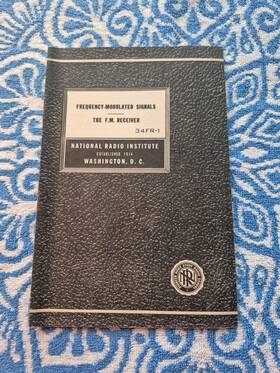
( Brand: National ), ( Manufacturer Part Number: 34FR-1 ), ( Type: Handbook ), ( Language: English ), ( Era/year: 1973 ), ( Features: Vintage ), ( Band: Fm )
Review NATIONAL Radio Institute Frequency modulated Signals.m. Receiver
The **National 34FR-1 Radio Institute Frequency-Modulated (FM) Receiver** is a meticulously engineered, mid-century military-grade radio designed for precision communication, reliability, and durability in demanding operational environments. Built with a robust, all-metal chassis and a ruggedized construction, this receiver exemplifies the engineering prowess of its era while maintaining unparalleled performance in both static and mobile applications. The 34FR-1 operates within the high-frequency (HF) and very high-frequency (VHF) bands, specifically tuned to the FM spectrum, making it an ideal choice for secure, clear, and interference-resistant voice and data transmission. Its frequency range spans from **2 to 30 MHz** (with optional extensions for broader coverage), ensuring compatibility with a wide array of military, government, and emergency communication networks. The receiver incorporates a **superheterodyne design**, featuring a high-stability crystal-controlled oscillator and a selective bandpass filter to minimize adjacent-channel interference, delivering crisp audio output even in noisy environments.
One of the standout features of the 34FR-1 is its **adjustable sensitivity and selectivity controls**, allowing operators to fine-tune performance for optimal signal reception. The front panel houses a **dial-mounted tuning knob** with clear, numbered frequency markings, complemented by a **fine-tuning vernier control** for precise channel selection. A **signal strength meter** provides real-time feedback, enabling quick adjustments to maintain strong connections. The receiver also includes a **built-in audio amplifier** with volume and squelch controls, ensuring clear voice transmission without background noise. For enhanced security, the 34FR-1 incorporates **frequency modulation (FM) with optional encryption capabilities**, making it suitable for classified communications where signal integrity is paramount.
Designed for both portable and fixed installations, the 34FR-1 is equipped with **multiple antenna inputs**, including a **coaxial BNC connector** for high-frequency signals and a **screw-terminal phono jack** for lower-frequency applications. Its **AC/DC dual-power capability** allows for flexible deployment, whether powered by a standard electrical outlet or a robust 12V DC source, making it adaptable for field operations or stationary setups. The unit s **metal enclosure** is both protective and thermally efficient, dissipating heat effectively to prevent overheating during prolonged use. Additionally, the 34FR-1 features **modular connectivity**, with provisions for external accessories such as microphones, speakers, or auxiliary equipment, expanding its functionality for specialized applications.
Built to withstand the rigors of military and field use, the 34FR-1 incorporates **durable mounting hardware**, including a **sturdy baseplate** for desk or rack installation, as well as **adjustable brackets** for wall or vehicle mounting. Its **knob-and-switch interface** is intuitive yet robust, with **military-grade switches** that resist wear and environmental degradation. The receiver s **front-panel indicators**, including a **power-on light** and **signal presence LED**, provide immediate status confirmation, while the **rear-panel connectors** are clearly labeled for easy troubleshooting and maintenance. Though originally developed for institutional and defense use, the 34FR-1 remains a prized collector s item among vintage radio enthusiasts and a dependable workhorse for modern ham radio operators, emergency responders, and communication technicians seeking a blend of historical craftsmanship and uncompromising performance.
### Pros and Cons of buying a National 34FR-1 FM Receiver
#### **Pros:**1. **Reliable Performance** The National 34FR-1 is a well-regarded analog FM receiver known for its stable and clear reception of frequency-modulated signals. It is designed for professional and industrial applications, ensuring consistent performance in environments where signal integrity is critical.
2. **Durability and Build Quality** As a ruggedized piece of equipment, the 34FR-1 is built to withstand harsh conditions, including temperature fluctuations, vibration, and electrical noise. This makes it suitable for field use, manufacturing plants, or other demanding environments.
3. **Wide Frequency Range** The receiver covers a broad FM range (typically 88 108 MHz in most regions), allowing it to pick up a variety of broadcast and private FM signals. This flexibility is useful for monitoring multiple frequencies without needing additional hardware.
4. **Low Maintenance** Being a simple analog device, it requires minimal upkeep compared to digital or complex electronic systems. There are no moving parts that wear out quickly, reducing long-term operational costs.
5. **Compatibility with Legacy Systems** If your organization still relies on analog FM communication (e.g., in older industrial setups, aviation ground control, or emergency services), this receiver ensures seamless integration without requiring upgrades to digital infrastructure.
6. **Affordability** Compared to modern digital receivers or more advanced analog models, the 34FR-1 is often cost-effective. Its simplicity also means lower repair and replacement costs over time.
7. **No Dependence on Software or Firmware** Unlike digital receivers, which may require updates or software dependencies, the 34FR-1 operates purely on hardware, reducing the risk of compatibility issues or obsolescence due to software changes.
---
#### **Cons:**1. **Limited to Analog FM Signals** The receiver does not support digital FM (e.g., HD Radio, DRM, or digital audio broadcasting). If your needs include modern digital broadcasting or advanced audio formats, this model will not suffice.
2. **No Built-in Digital Features** There are no digital outputs (e.g., USB, Bluetooth, or audio interfaces) for easy integration with recording devices or computers. You may need additional equipment to capture or process the audio signal.
3. **Manual Tuning Required** Unlike modern receivers with digital displays and presets, the 34FR-1 relies on manual tuning, which can be less convenient for quick or frequent channel changes. This may be cumbersome in dynamic environments where rapid frequency switching is needed.
4. **No Noise Reduction or Equalization** Advanced receivers often include features like noise cancellation, equalization, or signal enhancement. The 34FR-1 lacks these, which may result in slightly poorer audio quality in noisy environments compared to more modern receivers.
5. **Limited Display and Controls** The interface is basic, with minimal feedback (e.g., no digital readout of frequency or signal strength). This can make troubleshooting or verifying reception more difficult than with a digital display.
6. **Potential for Interference** While rugged, analog receivers can still be affected by electrical interference, especially in industrial settings with heavy machinery or poor shielding. Digital receivers often have better interference rejection capabilities.
7. **Obsolescence Risk** As digital broadcasting becomes the standard, analog-only equipment like the 34FR-1 may become less relevant over time. Future-proofing may require additional investments in digital receivers or adapters.
---
### **Conclusion:**The National 34FR-1 FM receiver is a robust, reliable, and cost-effective choice for applications where **analog FM signals are the primary requirement**, and durability in harsh environments is a priority. It excels in industrial, field, or legacy systems where simplicity and low maintenance are valued. However, it is not suitable for modern digital broadcasting, advanced audio processing, or applications requiring digital outputs or user-friendly interfaces.
If your use case involves **only analog FM reception in stable environments** (e.g., monitoring private FM networks, older broadcast systems, or non-critical industrial communication), the 34FR-1 is a solid investment. For **digital broadcasting, advanced audio features, or future-proofing**, a modern digital receiver would be a better long-term solution.
---
### **Recommendation:** - **Buy the 34FR-1 if:**- You need a **durable, analog-only FM receiver** for industrial, field, or legacy systems.
- Your budget is limited, and you prioritize **low maintenance and simplicity**.
- You operate in environments where **digital interference or obsolescence are not concerns**.
- **Avoid the 34FR-1 if:**- You require **digital FM, HD Radio, or advanced audio features**.
- Your application demands **easy integration with modern devices** (e.g., computers, recorders).
- You anticipate **future upgrades to digital broadcasting** and want a more adaptable solution.
For most modern or growing applications, investing in a **digital FM receiver with USB/audio outputs and noise reduction** would be more versatile. However, the 34FR-1 remains a practical choice for niche analog-focused use cases.
Details:
The National Radio Institute Frequency-modulated Signals Handbook from 1944 is a vintage guide focusing on FM receiver model's like the 34FR-1. Written in English, this manual provides valuable insights and instructions for tuning operating FM radio equipment. I have several different ones listed.
part #: 34fr1 price
- $7.87
specifications radiomanumag:
- brand: National
- mpn: 34fr-1
- type: Handbook
- language: English
- era/year: 1973
- features: Vintage
- band: Fm
seller radiomanumag:
- city: East Jordan, Michigan
- rating: 100.0%
- # reviews: 590
general radiomanumag:
- Radio Communication > Parts Accessories > Manuals Magazines
- condition: Like New
returns radiomanumag:
- policy: No Returns
payments radiomanumag:
- wallet: Google-pay
- credit card: Visa
- other
shipping radiomanumag:
- service: USPS Media Mail
- transit: 5-11 Days
- carrier: USPS
- cost: $0.00
- class: Economy
- type: Calculated
offer radiomanumag:
- best offers: True
- quantity: 1
- availability: In Stock
- sold: 0
- started: March 13, 2026
- options: Ship-to-home
National 34FR-1 Is Similar To:
- National Nc-183t Nc-183r And Multiband Radio Receiver Photofact (37.1% similar) This is a photo fact repair info for National model NC-183R NC-183T multi band radio receiver...(December 31st, 2023)
- National Rao-7 Original Navy Radio And Parts Manual For Rao-6 7 9 (38% similar) Its obvious they have been around since 1944. These are not copies. Includes some technical info like voltage tests and schematic. Original navy manuals for the operation and parts. These are original manuals and still fairly well bound...(May 12th, 2024)
- National Nc-108 Vintage Instruction Manual For The Model F M Receiver (58.1% similar) Please look at all pictures closely before purchasing. Everything you see in the pictures is what included this lot. Items may need a more in depth cleaning. Photos are the best...(January 24th, 2025)
- National Hro-5 Hro-5t Hro-5r Hro Hro-sr Receiver Manual (39.4% similar) Photos are the best. Please look at all pictures closely before purchasing. Items may need a more in depth cleaning. Everything you see in the pictures is what included this lot...(January 24th, 2025)
- National 015012538618 Radio Anniversary Photo Album Our Golden Wedding 1914-1964 (29.3% similar) Items may need a more in depth cleaning. Please look at all pictures closely before purchasing. Everything you see in the pictures is what included this lot. Photos are the best...(January 14th, 2026)
- National 23rf-2 Radio Institute Broadcast All Wave And Television Superheterodyne Receive (55.4% similar) The National radio institute broadcast all wave television supersaturating receiver handbook from 1943 is a vintage manual that provides insights into the operation and maintenance of brands model 23RF-2. With a focus on all wave and television supersaturating reception, this handbook offers ...(March 13th, 2026)
- National 27rf-2 Radio Institute Loud Speakers And How They Operate (58.7% similar) Written in english, this handbook offers insights into the design and functionality of loudspeakers, making it a unique informative piece for collectors enthusiasts alike. The National radio institute loudspeaker handbook 27RF-2 is a vintage manual from 1944 that provides detailed information on how...(March 13th, 2026)
- National 13rf-2 Radio Institute Special Power Supplies For Equipment (45.5% similar) The handbook is a valuable resource for those interested in radio communication and consumer electronics from the MID-20TH century, offering insights into technology practices of that era. Made in the USA, this handbook is a unique piece of history for collectors and enthusiasts vintage radio ...(March 13th, 2026)