NATIONAL RADIO INSTITUTE 38CCX Broadcast Studio Practices
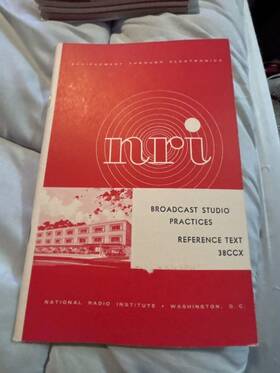
( Brand: National Radio Institute ), ( Manufacturer Part Number: 38CCX ), ( Size: One Size ), ( Features: Vintage ), ( Subject: Broadcast Studio Practices ), ( Era/year: 1970s ), ( Language: English ), ( Type: Manual )
Review NATIONAL RADIO INSTITUTE Vintage Broadcast Studio Practices Reference Text
The **National Radio Institute s *38ccx: Broadcast Studio Practices (1971)*** is a meticulously crafted, time-honored guide that stands as a cornerstone for aspiring broadcasters and seasoned professionals alike, offering an unparalleled deep dive into the foundational principles of radio production during the golden era of analog broadcasting. Originally designed as part of the institute s comprehensive curriculum, this manual serves as an authoritative blueprint for mastering the technical, artistic, and operational intricacies of studio operations in the early 1970s a period when radio was transitioning from simple microphone-and-amplifier setups to sophisticated, multi-channel soundscapes. The text meticulously dissects the anatomy of a professional broadcast studio, from the selection and placement of microphones (including dynamic, condenser, and ribbon types) to the calibration of equalizers, compressors, and mixers, all while emphasizing the delicate balance between clarity, tone, and audience engagement. Beyond hardware, the manual delves into the art of voice modulation, scriptwriting, and on-air delivery, providing practical exercises for developing natural, engaging diction and pacing skills that remain indispensable in today s digital-first media landscape. Additionally, it explores the logistical aspects of studio management, such as scheduling, equipment maintenance, and the nuances of live versus pre-recorded broadcasts, all framed within the ethical and professional standards of the time. Written with a clarity that bridges technical jargon and creative intuition, *38ccx* is not merely a historical artifact but a timeless resource that continues to inspire modern broadcasters to think critically about sound, storytelling, and the craft of radio. Whether used as a foundational textbook or a reference for vintage equipment enthusiasts, this manual remains a testament to the enduring power of analog broadcasting and the universal principles that define great audio work.
**Pros and Cons of Buying *National Radio Institute s *Broadcast Studio Practices* (38CCX, 1971 Edition)**
### **Pros**
1. **Historical and Educational Value**
The 1971 edition of *Broadcast Studio Practices* by the National Radio Institute (NRI) is a foundational text in radio broadcasting, offering insights into the technical, operational, and theoretical aspects of studio production from the early 1970s. For enthusiasts, historians, or students of radio history, this book provides a unique perspective on how broadcasting evolved during that era. It covers topics like analog audio engineering, studio layout, microphone techniques, and broadcast regulations that were standard practices at the time.
2. **Technical Depth for Analog Enthusiasts**
If you are interested in analog broadcasting, audio recording, or vintage radio technology, this book serves as an invaluable resource. It explains the principles behind vacuum tube amplifiers, tape recorders, and early broadcast consoles knowledge that is increasingly rare as digital systems dominate. For those restoring or operating vintage equipment, the practical advice on troubleshooting and maintenance is particularly useful.
3. **Practical Broadcast Knowledge**
The book includes hands-on guidance for studio operations, such as scripting, announcing, and managing live broadcasts. It also addresses the business side of radio, including audience engagement, programming strategies, and the role of broadcasters in society. This makes it useful not just for engineers but also for aspiring radio personalities or producers who want to understand the fundamentals of broadcast workflows from the past.
4. **Rarity and Collectibility**
As a book from the early 1970s, especially from a now-defunct institution like NRI, this edition may be difficult to find in good condition. Its scarcity could make it a desirable addition to a personal or professional library, particularly for collectors of broadcasting literature or those studying the history of media technology.
5. **Complementary to Modern Studies**
While much of the content is dated, the book provides a contrast to modern digital broadcasting practices. Comparing the analog techniques described in this text with contemporary methods can offer a deeper understanding of how the industry has progressed or regressed in some areas. It can also inspire creativity in adapting old techniques to new equipment.
---
### **Cons**
1. **Outdated and Obsolete Information**
The primary drawback of this book is its age. Much of the technical content such as details on vacuum tube circuits, analog tape recording, and early broadcast standards is no longer relevant to modern radio production. For someone working in today s digital broadcasting environment, much of the information will be irrelevant or even misleading without additional context. For example, the book does not address digital audio workstations (DAWs), modern mixing consoles, or internet-based broadcasting, which are now standard.
2. **Lack of Modern Context**
Broadcast regulations, industry standards, and even the structure of radio stations have changed dramatically since 1971. The book does not account for the rise of satellite radio, streaming services, podcasting, or the shift from analog to digital transmission. A reader relying solely on this text would miss critical updates to FCC regulations, audio compression standards (e.g., MP3, AAC), or the integration of social media into broadcasting.
3. **Potential for Misleading Advice**
Some of the "best practices" outlined in the book may now be considered outdated or even harmful. For instance, the book likely discusses analog noise reduction techniques that are no longer used, or it may promote practices that are now known to be inefficient or unsafe (e.g., certain vacuum tube handling methods). Without careful interpretation, a reader could inadvertently adopt outdated or incorrect techniques.
4. **Physical Condition and Accessibility**
Older books, especially those from specialized institutions like NRI, are prone to wear and tear. The 1971 edition may have faded text, brittle pages, or damaged bindings, which could make it difficult to read or store. Additionally, finding a copy in good condition may require searching through used bookstores, online auctions, or specialized libraries, which could be time-consuming or expensive.
5. **Limited Practical Application Today**
While the book is fascinating for historical and educational purposes, its practical utility for modern broadcasters or audio engineers is limited. Most of the technical diagrams, schematics, and workflows are tied to equipment that is no longer in use. For someone looking to apply the knowledge directly to current projects, the book will require significant supplementation with more recent resources.
---
### **Conclusion**
*Broadcast Studio Practices* (38CCX, 1971) is a valuable artifact for understanding the history of radio broadcasting and analog audio engineering. It offers deep technical and operational insights that reflect the state of the industry during its time, making it a must-have for collectors, historians, and enthusiasts of vintage broadcasting. However, its age renders much of the content obsolete or impractical for modern use. The book is not a standalone guide for contemporary broadcasters or engineers but rather a supplementary resource that should be paired with more recent materials.
For those interested in the evolution of broadcasting, the book provides a fascinating glimpse into the past and can serve as a thought-provoking comparison to today s digital landscape. For professionals working in radio today, it is more of a curiosity than a practical tool though it may spark inspiration for creative or educational projects.
---
### **Recommendation**
**Buy the book if:**- You are a collector of vintage broadcasting literature or a student of radio history.
- You are restoring or operating analog broadcasting equipment and need historical technical references.
- You enjoy comparing past and present broadcasting practices and want a primary source from the early 1970s.
- You are teaching a course on the history of radio and need a firsthand account of studio practices from that era.
**Do not buy the book if:**- You are a modern broadcaster, audio engineer, or producer looking for up-to-date technical guidance.
- You need practical, hands-on advice for current broadcasting equipment or digital workflows.
- You are on a tight budget, as the book may be expensive due to its rarity and age.
- You prefer digital or more recent resources that align with contemporary industry standards.
**Alternative Approach:**If you are interested in the book s content but want a more practical resource, consider pairing it with modern textbooks on broadcasting (e.g., *The Broadcast Engineer s Handbook* by Robert E. Bell) or digital audio production. For historical context, supplement it with online archives, interviews with vintage broadcasters, or documentaries about the evolution of radio technology. The 1971 edition is best enjoyed as a historical document rather than a functional manual.
Details:
Includes original study schedule and technical illustrations. Vintage 1971 National Radio Institute NRI Reference for Broadcast Studio Practices, Code 38CCX. Perfect for collectors of Radio history, electronics enthusiasts, or media students. Contents include information on: - Basic Radio station plans Studio construction and acoustics Control room equipment operation Maintenance of electronic Remote broadcast procedures condition: Good vintage condition.
Printed in the USA. Pages are intact with standard age-related yellowing. This educational manual provides a deep look into the technical and operational aspects of Radio broadcasting from early 1970s.
part #: 38ccx price
- $15.00
specifications radiomanumag:
- brand: National Radio Institute
- mpn: 38ccx
- size: One Size
- features: Vintage
- subject: Broadcast Studio Practices
- era/year: 1970s
- language: English
- type: Manual
offer Radiomanumag:
- availability: In Stock
- started: May 31, 2026
- best offers: True
- sold: 0
- quantity: 1
- options: Ship-to-home
general Radiomanumag:
- condition: Very Good
- Radio Communication > Parts Accessories > Manuals Magazines
payments Radiomanumag:
- credit card: Visa
- wallet: Apple-pay
- other
seller Radiomanumag:
- # reviews: 147
- rating: 100.0%
- city: Herkimer, New York
shipping Radiomanumag:
- transit: 8-13 Days
- service: Standard
- class: Standard
- type: Fixed
- cost: $7.39
returns Radiomanumag:
- time: 14 Days
- method: Money back
- paid by: Buyer
- policy: Returns Accepted
National Radio Institute 38CCX Is Similar To:
- National Nc-183t Nc-183r And Multiband Radio Receiver Photofact (32.4% similar) This is a photo fact repair info for National model NC-183R NC-183T multi band Radio receiver...(December 31st, 2023)
- National Rao-7 Original Navy Radio And Parts Manual For Rao-6 7 9 (33.3% similar) Its obvious they have been around since 1944. These are not copies. Includes some technical info like voltage tests and schematic. Original navy manuals for the operation and parts. These are original manuals and still fairly well bound...(May 12th, 2024)
- National Nc-108 Vintage Instruction Manual For The Model F M Receiver (41% similar) Please look at all pictures closely before purchasing. Everything you see in the pictures is what included this lot. Items may need a more in depth cleaning. Photos are the best...(January 24th, 2025)
- National 015012538618 Radio Anniversary Photo Album Our Golden Wedding 1914-1964 (32.7% similar) Items may need a more in depth cleaning. Please look at all pictures closely before purchasing. Everything you see in the pictures is what included this lot. Photos are the best...(January 14th, 2026)
- National 34fr-1 Radio Institute Frequency-modulated Signals The F.m Receiver (42% similar) The National Radio Institute frequency-modulated signals handbook from 1944 is a vintage guide focusing on FM receiver model's like the 34FR-1. Written in english, this manual provides valuable insights and instructions for tuning operating FM Radio equipment. I have several different ones listed...(March 13th, 2026)
- National 23rf-2 Radio Institute Broadcast All Wave And Television Superheterodyne Receive (50.6% similar) The National Radio Institute broadcast all wave television supersaturating receiver handbook from 1943 is a vintage manual that provides insights into the operation and maintenance of brands model 23RF-2. With a focus on all wave and television supersaturating reception, this handbook offers ...(March 13th, 2026)
- National 27rf-2 Radio Institute Loud Speakers And How They Operate (49% similar) Written in english, this handbook offers insights into the design and functionality of loudspeakers, making it a unique informative piece for collectors enthusiasts alike. The National Radio Institute loudspeaker handbook 27RF-2 is a vintage manual from 1944 that provides detailed information on how...(March 13th, 2026)
- National 13rf-2 Radio Institute Special Power Supplies For Equipment (49.7% similar) The handbook is a valuable resource for those interested in Radio communication and consumer electronics from the MID-20TH century, offering insights into technology practices of that era. Made in the USA, this handbook is a unique piece of history for collectors and enthusiasts vintage Radio ...(March 13th, 2026)